World Labs Atlas Model Brings 3D Worlds You Can Move a Camera Through
World Labs has introduced Atlas, a world model that generates, reconstructs and simulates 3D scenes with full camera control — up to a minute of 1440p video — and is…

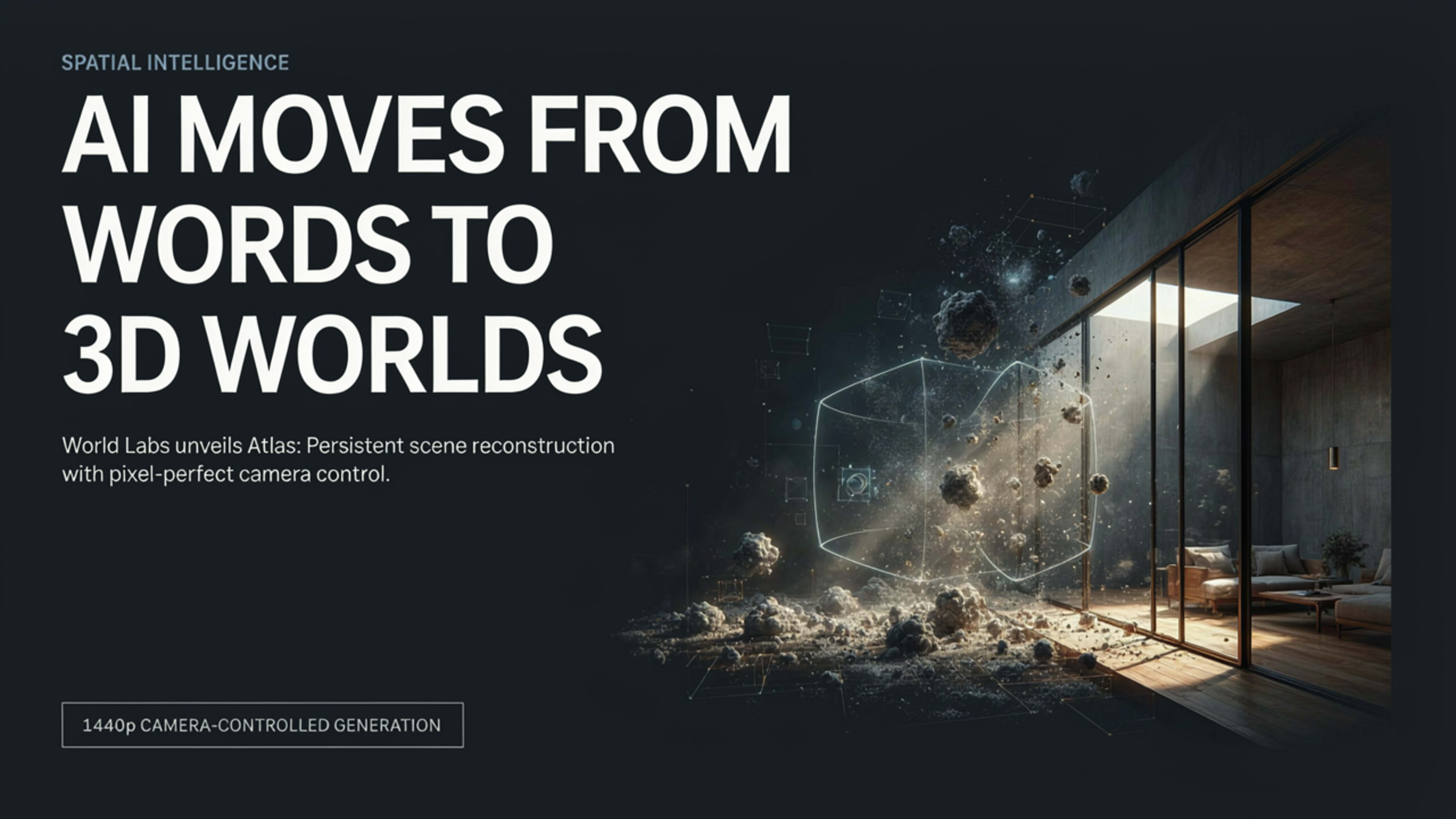
World Labs has introduced Atlas, a world model that generates, reconstructs and simulates 3D scenes with full camera control — up to a minute of 1440p video — and is entering early access with select partners.
The system represents the clearest articulation of the company’s founding premise: that the next frontier in artificial intelligence lies not in language prediction, but in spatial intelligence.
The Core Innovation
Most AI systems dominating the industry predict text. Atlas predicts worlds. World Labs describes it as an omni model for spatial intelligence — a multimodal autoregressive diffusion transformer that accepts text, images, video and 3D data natively, and produces scenes with 3D consistency that holds as users navigate through them.
That consistency is the core innovation. A traditional video model can generate a polished clip, but ask it to pan back to the starting position and the room has often rearranged itself. A world model is designed to remember.
Capabilities
The capabilities World Labs outlined are concrete:
Camera-controlled generation produces up to one minute of 1440p video with what the company calls pixel-perfect camera control. Users direct the camera; the underlying scene remains stable.
Spatial reconstruction converts a small set of sparse images into explicit 3D output — point clouds and Gaussian splats suitable for insertion into production pipelines.
Space-time simulation reframes video and enables scene simulation for robotics, where a machine requires a stable model of the space it occupies.
Image and 360-degree panorama generation from text prompts.
Performance Benchmarks
World Labs reports that on internal benchmarks, Atlas outperforms specialized models on camera-controlled generation between 75 and 94 percent of the time, depending on the competitor, and exceeds them on 3D reconstruction across several datasets. These are the company’s own figures, and preference tests carry inherent limitations, but the listed capabilities are specific enough to verify independently once the model reaches more hands.
Access and Availability
Access is currently restricted. Atlas is entering early access with select partners — a request form exists, but no public API or general availability has been announced. World Labs indicates the technology will power future versions of Marble, its creative tool, which may be where most users eventually encounter it.
The Vision Behind Atlas
World Labs is Fei-Fei Li‘s company. Li has argued for two years that spatial intelligence — a machine’s understanding of the physical, three-dimensional world — represents a capability language models conspicuously lack. Atlas turns that argument into a product: not a system that describes a room, but one that constructs a room, maintains its consistency, and permits a camera or robot to move through it.
Whether spatial intelligence becomes as central as Li predicts remains an open question. Language models succeeded in the previous cycle partly because text was ubiquitous and inexpensive to train on; 3D-consistent worlds offer neither advantage. But if AI’s next phase flows through robotics, simulation and immersive tools, the models that remember the room may matter more than those that can only describe it — and Atlas represents a substantive entry in precisely that competition.