Meghalaya Activates 35-Year-Old Catchwater Law as Villages Sign Historic Water Protection Agreements
Two villages in Meghalaya have signed agreements with the state government to protect critical watersheds, activating a law that has sat on the books since 1990.The MoUs, signed under the…

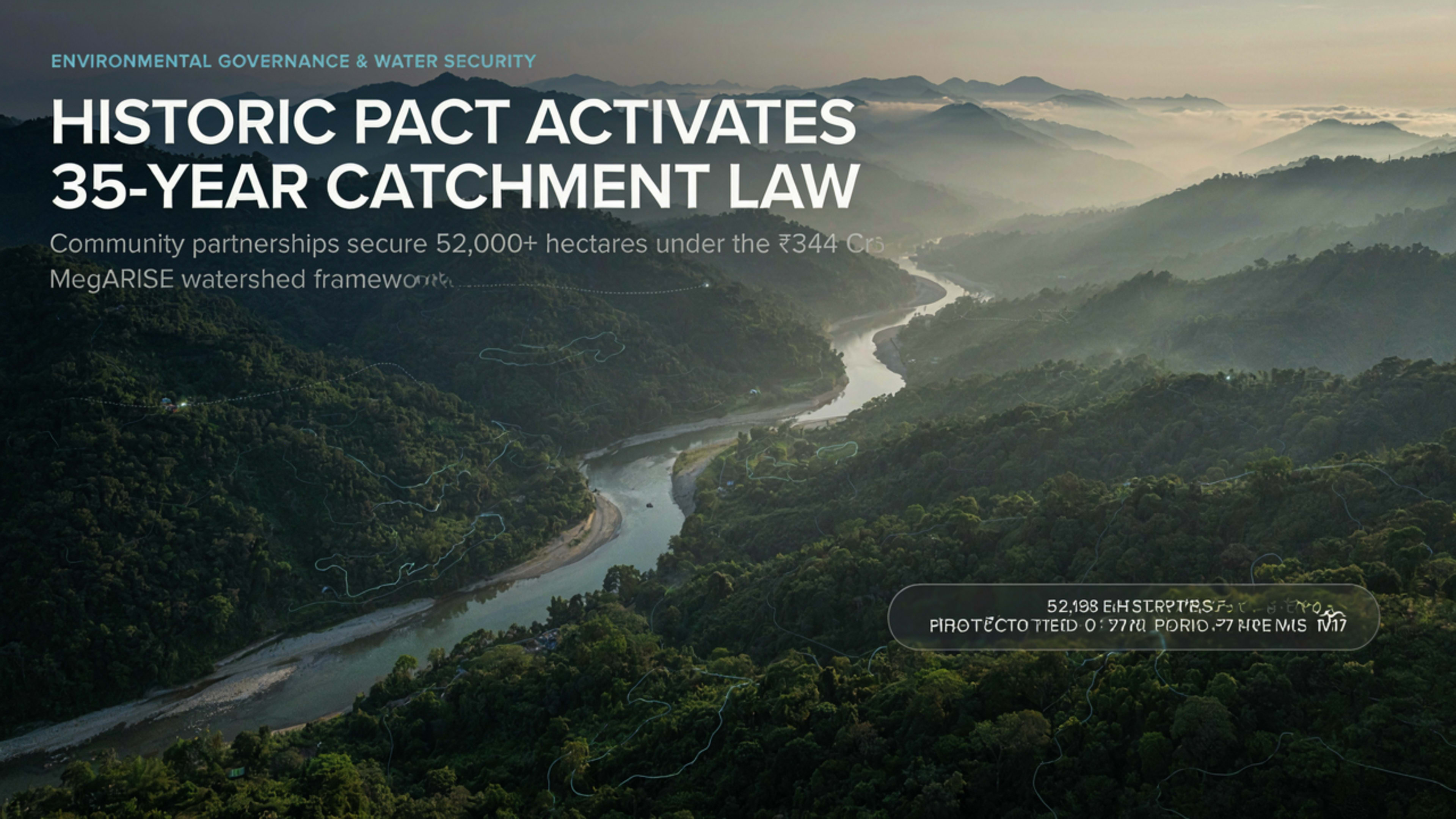
Two villages in Meghalaya have signed agreements with the state government to protect critical watersheds, activating a law that has sat on the books since 1990.
The MoUs, signed under the Meghalaya Protection Act, 1990, mark the first catchment declarations in India under such legislation. Pomlakrai Umiew and Durakalagre Ganol villages committed to protecting their respective catchments at an Integrated Partners’ Support and Engagement programme held at Matchakolgre LP School Playground in New Tura.
“Since the Act was passed in 1990, this is an important step. It required understanding and permission of local communities, a threshold never met till now. Today’s MoU is a historic breakthrough,” said Chief Minister Conrad K Sangma.
Project Scope and Funding
The agreements are anchored in the MegARISE project, a ₹344.4 crore initiative funded through KfW development bank financing—₹277.2 crore in external assistance paired with ₹67.2 crore in state funds. The project, operational from November 2022 through November 2029, covers 52,198 hectares across 77 micro-watersheds and 226 villages.
The Ganol catchment alone spans 39,714 hectares across 64 micro-watersheds and 132 villages in Rongram, Selsella, Rerapara, and Samanda blocks—representing 76 per cent of the total project area. The watershed underpins Tura’s water security and the ₹398 crore Greater Tura Water Supply Scheme. Umiew serves as Shillong’s principal water source.
Sangma linked the initiative to another flagship programme. “FOCUS+ raises seasonal income, MegARISE protects the water, soil and forest that income depends on,” he said.
FOCUS+ Programme Disbursement
At the event, the Chief Minister released ₹28.60 crore as the first installment of the 2026 FOCUS+ programme—₹2,500 each to 114,400 beneficiaries across the state. The disbursement includes 93,285 existing beneficiaries, 12,045 households processed in March 2026, and 9,070 newly registered families.
Each farming household receives an annual untied grant of ₹5,000 in two direct benefit transfer tranches for purchasing seeds, feed, or equipment.
Of the 9,070 new beneficiaries, 7,074—78 per cent—belong to Garo Hills districts. These new recipients account for 87,959 beneficiaries, or 76.9 per cent of the statewide total. West Garo Hills leads all districts with 37,330 beneficiaries.
Registration will continue on a quarterly cycle, with a target of reaching 2.5 to 3 lakh households, the Chief Minister said.
The programme also featured the flagging off of AGEY vehicles for self-help groups under the Meghalaya State Rural Livelihoods Society to improve market access, along with the presentation of MegARISE Community Awards.
Sangma described the implementation as critical for a state that receives nearly 50 per cent of the country’s highest rainfall.