Stoke Space Closes $1 Billion Funding Round to Build Fully Reusable Rockets
Stoke Space has secured roughly one billion dollars in new funding, a bet by investors that the Kent, Washington-based company can accomplish what only SpaceX has attempted: building a rocket…

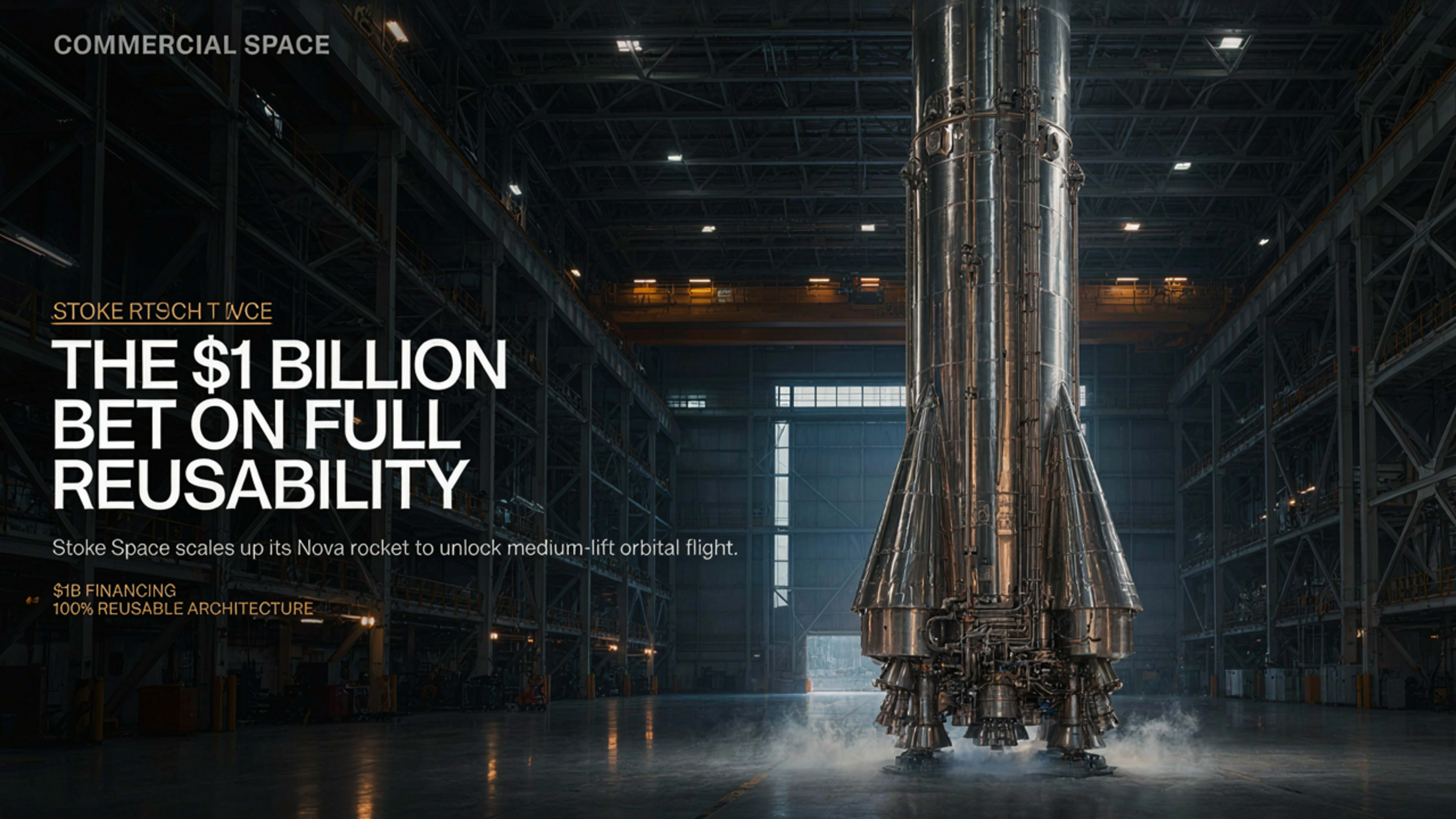
Stoke Space has secured roughly one billion dollars in new funding, a bet by investors that the Kent, Washington-based company can accomplish what only SpaceX has attempted: building a rocket designed to fly, return, and fly again with minimal refurbishment.
The round was led by Point72 Ventures and Spark Capital, with participation from General Innovation, Glade Brook Capital, US Innovation Technology, Washington Harbour Partners, Woven Capital, Y Combinator, and others. According to co-founder and chief executive Andy Lapsa, the final amount falls “within rounding error” of one billion dollars.
The fundraising came together quickly. Lapsa described the pace as “very fast,” attributing it to steady engineering progress and growing pressure across the launch industry. Launch slots are tightening as demand for orbital missions continues to climb, and Stoke is positioning itself to address that gap.
Two-Rocket Strategy
The company is pursuing a two-rocket strategy. Its original design, now called Nova Pathfinder, has been in development since Stoke’s founding in 2019. The first stage will use seven of Stoke’s in-house Zenith engines, while the upper stage relies on a single Andromeda engine paired with 24 integrated thrust chambers behind an actively cooled metallic heat shield. That combination is meant to make the entire vehicle reusable, with the booster returning to a recovery ship and the upper stage surviving re-entry on its own thermal protection.
Nova Pathfinder can deliver roughly three metric tons to low Earth orbit. Its inaugural launch is slated for early 2027, carrying a spacecraft for AstroForge, a California company pursuing asteroid prospecting and rare-earth mining. Lapsa noted the mission will target the asteroid belt, making it an ambitious first flight for a rocket that has yet to reach orbit.
The larger variant, Nova Block 2, is expected to debut in 2029. It will double the first-stage Zenith count to 14 and replace the upper-stage configuration with 12 independent engines, each containing two thrust chambers. That increase in power lifts Nova’s capacity fivefold, enabling roughly 15 metric tons to LEO and more than four metric tons to geostationary transfer orbit. For context, SpaceX’s Falcon 9 delivers about 18.5 metric tons to LEO in reusable mode, placing Block 2 squarely in the medium-lift class.
Stoke’s approach to upper-stage reuse centers on circulating cryogenically cooled liquid hydrogen through channels in a metallic heat shield to manage re-entry temperatures. The company argues this active cooling system offers a more reliable path to returning the upper stage than the heat shield strategies SpaceX has tested on Starship. Stoke has no plans to compete at the super-heavy end of the market; instead, it sees the medium-lift segment as underserved and increasingly critical.
Infrastructure Expansion
The funding will support infrastructure alongside design work. Stoke’s 168,000-square-foot headquarters and factory in Kent was built with larger rockets in mind, using manufacturing methods and tooling compatible with wider diameters and longer airframes. The team can take raw sheet metal and produce a complete rocket without outsourcing, a capability the facility was sized to scale with the company’s ambitions.
More dramatic expansion is underway in Moses Lake, Washington. The test complex is growing from 75 to 550 acres. The current site suffers from overlapping blast zones, preventing simultaneous operation of some test stands. Spreading out will let Stoke test Pathfinder and Block 2 hardware in parallel with full independence between stands. Lapsa said the team has done “an extremely efficient job” with the existing footprint, but the expansion will allow testing at a higher cadence as production ramps.
Stoke’s launch pad at Cape Canaveral Space Force Station in Florida is being readied for both rocket variants. A new payload processing facility at the site was deliberately sized to handle Nova Pathfinder and Nova Block 2.
Path to First Launch
The near-term focus is clearing Pathfinder’s preflight checklist. In June, Stoke finished proto-qualification testing of the first-stage booster at Moses Lake. The second stage is poised to arrive there for structural acceptance testing and a full static hot-fire. Once both stages pass, they ship to Cape Canaveral for final integration. The team will repeat wet dress rehearsals performed in Moses Lake, this time on the actual pad, followed by a first-stage static fire. The stages then join, and the rocket goes to space.
Stoke was founded in 2019 by Lapsa and chief technology officer Tom Feldman after they left Blue Origin. The company now employs roughly 400 people: about 50 in Moses Lake, 50 at Cape Canaveral, and the rest in Kent.
For a company that has never reached orbit, Stoke has drawn unusual investor confidence. Point72 Ventures partner Chris Morales said Stoke has shown “exceptional technical progress” and the ambition to build a launch system for the market. Spark Capital general partner Clay Fisher argued that full reusability represents the market’s inevitable end state and that Stoke has matched “a prescient vision with a blistering pace of execution.”
Lapsa cast the moment in broader terms. “Space development is incredibly important for civilization to continue scaling and improving quality of life,” he said. For him, the raise is both validation of the team’s work and a signal that experienced investors are taking the long-term vision seriously.
With a billion dollars in funding, a defined path to the launch pad, and plans for a larger vehicle to follow, Stoke Space has moved beyond the category of promising startup. It is becoming one of the more consequential bets in the next phase of commercial spaceflight.