Open Research Project Cuts Quantum Attack Cost Estimate for Blockchain Encryption by 86%
A collective of human researchers and AI agents has dramatically lowered the estimated quantum computing resources needed to attack the encryption underlying Bitcoin, Ethereum and other blockchain networks.The project, c…

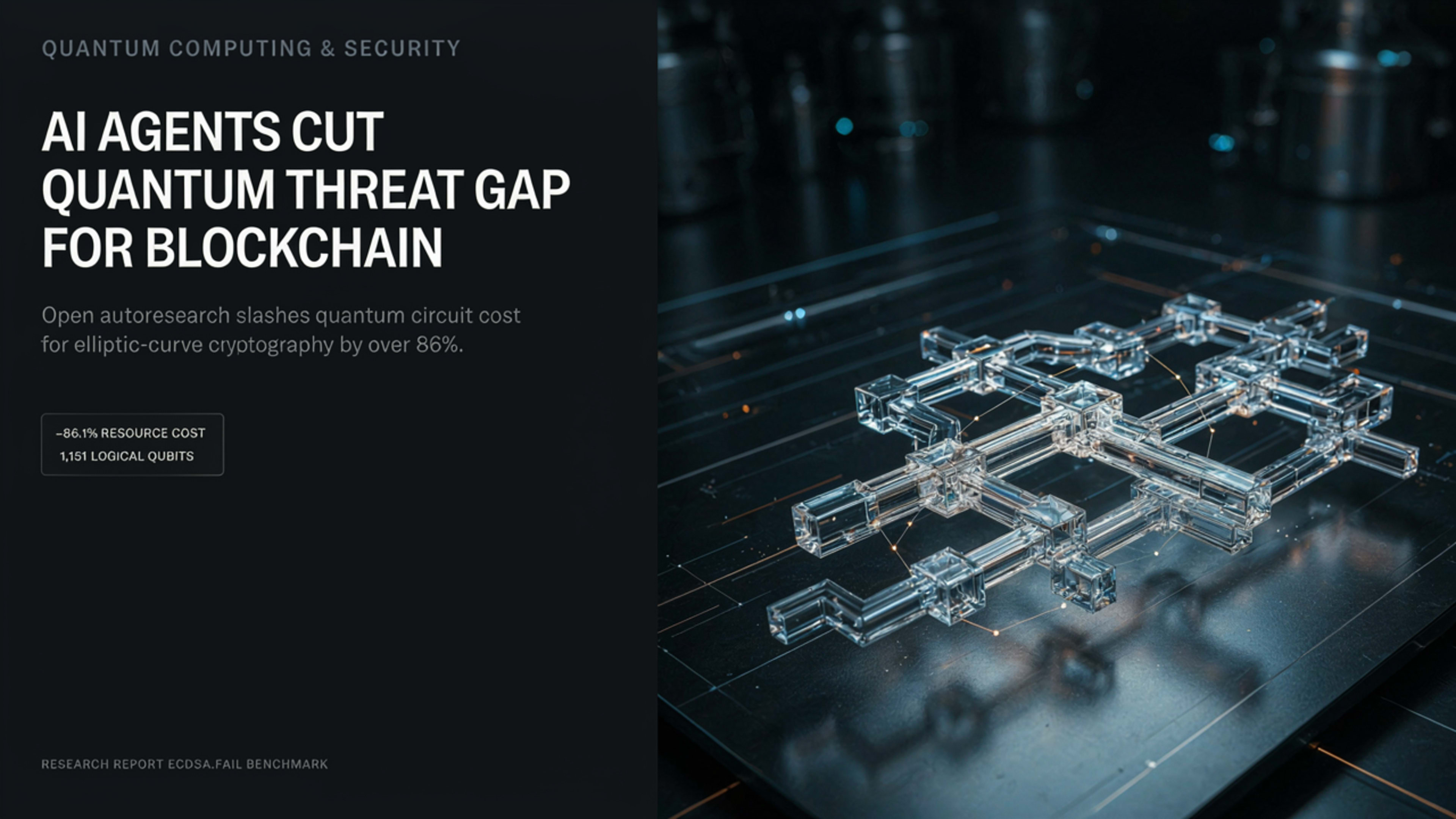
A collective of human researchers and AI agents has dramatically lowered the estimated quantum computing resources needed to attack the encryption underlying Bitcoin, Ethereum and other blockchain networks.
The project, called ECDSA.Fail, reduced its principal performance metric by 86.1% from its starting point. By the study’s data cutoff, the leading circuit required 1,151 logical qubits and roughly 1.3 million Toffoli gates to perform elliptic-curve point addition, one of the core arithmetic operations in Shor’s algorithm.
Significance for Blockchain Cryptography
The work does not demonstrate an actual attack on Bitcoin or show that current quantum computers can recover cryptocurrency private keys. Instead, it narrows estimates of what a future fault-tolerant machine would need to execute a single step of such an attack.
“As quantum hardware advances, we need credible, reproducible estimates of the resources required to break deployed cryptography. Those estimates help us understand the remaining gap and plan migration before it closes,” said Jieyi Long, lead author and co-founder and CTO of Theta Labs. “Across over a hundred contributors the collective effort halved the cost estimate of the central arithmetic step. The consequence falls hardest on blockchains, because a public key written to a ledger is exposed permanently and roughly a third of all bitcoin already sits in addresses where the key is visible. None of this is urgent because an attack is imminent. It is urgent because the remedy takes years and cannot be applied retroactively.”
Methodology and Benchmarks
The study, posted on arXiv, focused on secp256k1, the elliptic curve used by Bitcoin, Ethereum and several related systems. The team measured circuits by multiplying their peak logical qubit count by their average Toffoli-gate count, an approximate gauge of the space and computational work a fault-tolerant machine would require.
ECDSA.Fail began with a circuit demanding 2,715 logical qubits and 3,960,753 Toffoli gates. By the July 26 cutoff, the best entry brought those figures down to 1,151 logical qubits and 1,299,453 Toffoli gates—reductions of 57.6% and 67.2% respectively. The combined score fell to roughly one-seventh of the baseline.
The result also ran more than 50% below a point-addition benchmark reported by Google researchers, though the teams used different interfaces, assumptions and accounting methods, making a direct comparison difficult. After the formal cutoff, contributors drove the combined score lower still, to approximately 1.259 billion, using 1,321 logical qubits and under one million average executed Toffoli gates. A separate effort optimized for quantum memory produced a circuit with 813 logical qubits but required substantially more operations.
“Google kept its circuits private. ECDSA.fail’s open community and AI agents more than halved Google’s benchmark score in about two months. Starknet’s proofs are hash-based and post-quantum by design. The industry must upgrade before quantum hardware catches up,” said Oli Freuler, Head of Product Growth at StarkWare.
Open Autoresearch Model
The project also served as a test of what the researchers call open autoresearch. In this model, scientists and AI agents work toward a shared, machine-checkable goal while publishing verified improvements to a common repository and leaderboard. Eigen Labs launched the challenge in late May 2026. Over approximately eight weeks, participants generated more than 400 promoted submissions.
Contributors could modify circuits directly or use AI coding agents to propose changes, run tests and document failed approaches. Some teams employed research agents to generate ideas and an engineering agent to convert promising results into polished code. Others used an orchestrating agent or person to distribute possible improvements among several focused agents. Human researchers generally selected goals, supplied mathematical knowledge, reviewed outputs and redirected searches that had stalled.
Each submitted circuit was tested against three requirements: it had to produce the correct point-addition result, return temporary qubits to their original state and avoid leaving phase changes that would disrupt the broader calculation. Verified improvements became available as starting points for other participants. The public record also preserved some unsuccessful experiments, potentially helping later researchers avoid repeating dead-end work.
“Open autoresearch, pioneered by ecdsa.fail, is reshaping Ethereum L1 R&D. Live challenges zk.golf, snark.fast, better.codes, precompile.fast produce in weeks what would have taken months or years. A collaborative community armed with AI is magic,” said Justin Drake, a researcher at the Ethereum Foundation.
“AI harnesses and agentic workflows are becoming new tools for reorganizing exploration in hard problems,” said Dr Bartosz Naskręcki, Professor of Mathematics and Computer Science at Adam Mickiewicz University in Poznań. “The ecdsa.fail project, initiated by EigenLabs, has spawned a community of researchers who are collaboratively reshaping the landscape of algorithmic security. Their methods are resonating with other challenges and showing that a new paradigm of research is being born.”
“What ECDSA.Fail showed us is that AI agents become much more powerful when they are not working in isolation,” said Soubhik Deb, Head of Research at Eigen Labs. “When many independent researchers and agents can explore different approaches, verify improvements against the same benchmark, and build on each other’s work, progress compounds. That insight became a core part of how we think about open autoresearch at Eigen Labs, and what we’re now expanding through Yukon.”
Study Limitations
The team emphasized that their results are leaderboard measurements, not complete estimates for a working cryptographic attack. The benchmark covers only point addition, not the full execution of Shor’s algorithm. It omits physical quantum error correction, hardware-specific compilation, certain operational costs and end-to-end testing of a complete attack. Logical-qubit estimates cannot be directly translated into the physical-qubit counts a real machine would demand.
The main benchmark also supplies one input to each point addition as classical information. A full windowed implementation of Shor’s algorithm must select that information coherently within the quantum calculation. To explore this constraint, the researchers built a compatible version requiring 1,162 logical qubits and an average of 1,684,161 Toffoli gates—11 additional logical qubits and roughly 29.6% more Toffoli operations per addition. That test demonstrated a single compatible point-addition call rather than a complete quantum attack.
Correctness was evaluated across 9,024 generated test cases rather than proved mathematically for every possible input. Participants could modify a circuit’s identifying data to produce a different test set, creating a possibility that a circuit with infrequent errors could pass the benchmark. The team addressed this partly by testing selected circuits on 50,000 common pseudorandom inputs and adjusting scores for observed failure rates. Success rates stayed close to 100%, and the adjusted trend matched the original results closely. The researchers noted, however, that the tests do not provide a universal correctness guarantee.
The scoring system also excludes circuit depth and the degree to which operations can run in parallel. Two circuits with identical qubit and gate counts could receive the same score even if one would take far longer to execute on actual hardware.
Next Steps
The next planned step is to incorporate the optimized point-addition circuit into a complete windowed implementation of Shor’s algorithm, integrating the remaining arithmetic, quantum Fourier transform stages and classical processing needed to recover a key. That work would also require end-to-end validation using consistent resource accounting.
It is important to note that arXiv is a preprint server, allowing researchers to receive rapid feedback on their work. Neither the paper nor this article constitutes a peer-reviewed publication. Peer review remains a critical step in verifying scientific results.