Fujitsu Unveils First Diamond-Spin Quantum Computer Prototype Using Tin-Vacancy Centers
Fujitsu has built the world's first working prototype of a diamond-spin quantum computer that embeds tin-vacancy (SnV) centers into photonic integrated circuits, the company announced from Kawasaki, Japan.The system oper…

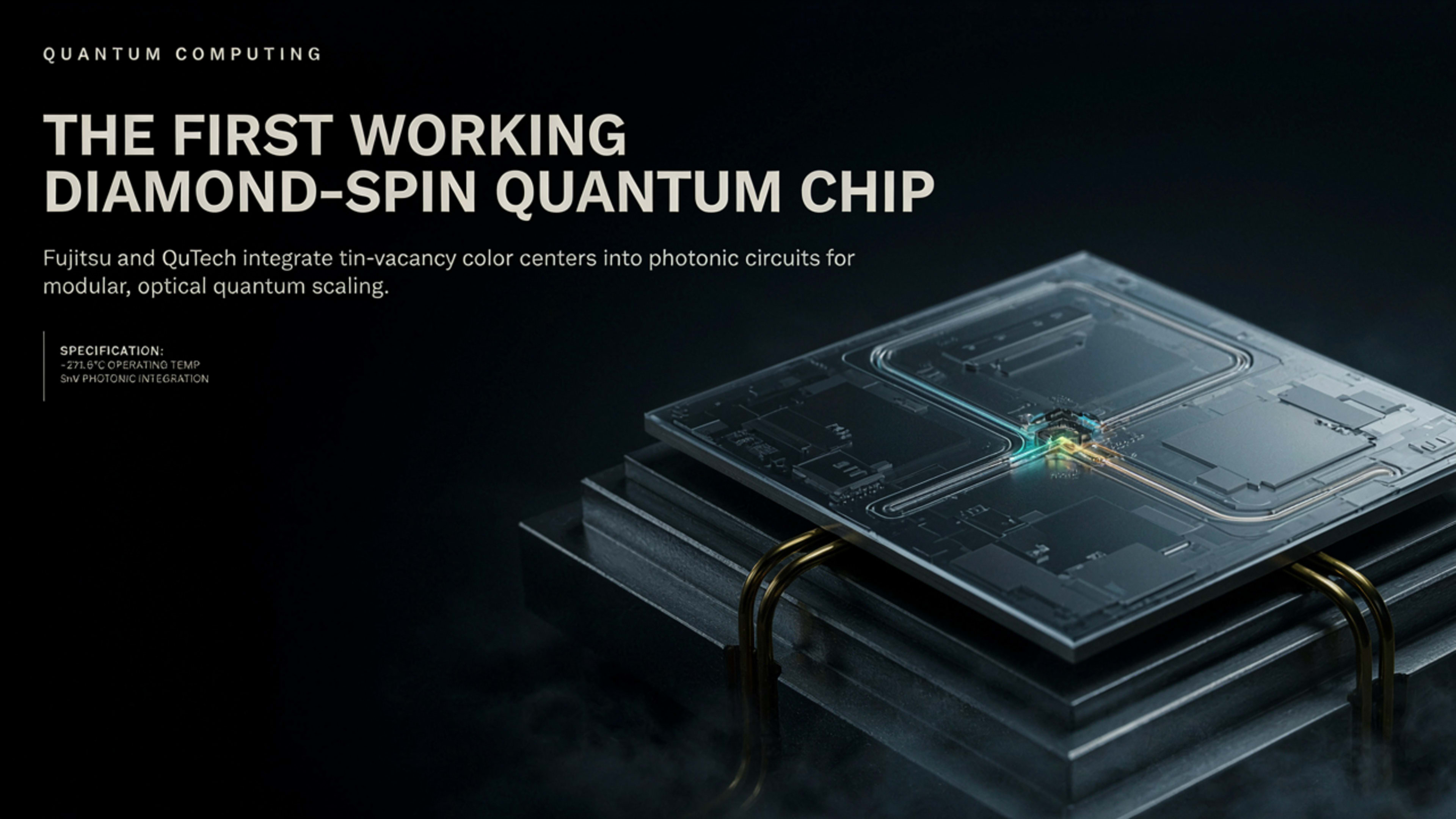
Fujitsu has built the world’s first working prototype of a diamond-spin quantum computer that embeds tin-vacancy (SnV) centers into photonic integrated circuits, the company announced from Kawasaki, Japan.
The system operates at -271.6°C—warmer than the -273.13°C required by conventional superconducting quantum computers. In a test environment, Fujitsu accessed the prototype through its existing Hybrid Quantum Computing Platform without requiring specialized expertise from operators.
The achievement marks a significant step toward modular quantum computing architectures, which researchers consider among the most viable paths to scaling quantum systems. Modular designs promise high fidelity and efficient optical connections between components.
“The diamond-spin approach we have applied in this prototype not only offers exceptional scalability in its own right, but also has the potential to be integrated with superconducting quantum computers to further extend their capabilities, enabling more complex and large-scale computations,” said Vivek Mahajan, Corporate Executive Officer, CTO, and Corporate Vice President in charge of System Platform at Fujitsu.
The prototype draws from joint research launched in 2020 with Delft University of Technology and QuTech, a leading quantum technology institute affiliated with TU Delft.
“It is a major milestone in our strong collaboration,” said Dr. Kees Eijkel, General Director of QuTech. “Demonstrating the scalability expected of diamond spin quantum computing remains a long and challenging journey. However, by further strengthening our collaboration with Fujitsu, we are committed to tackling this ambitious and meaningful challenge and leading the development of next-generation quantum technologies.”
Fujitsu plans to demonstrate a multi-module version of the system by 2027 and is already working on integrating the diamond-spin method with superconducting approaches to accelerate progress toward large-scale quantum computers. The company aims to deliver practical quantum computing capabilities by 2030.
Under Fujitsu‘s roadmap, the goal is a 250-logical-qubit system by fiscal 2030 and a 1,000-logical-qubit system by fiscal 2035.
How the system works
The diamond-spin approach exploits lattice defects in diamond crystals called color centers. Diamond’s inherent properties allow quantum states to remain stable longer than in other materials, potentially enabling reliable logical qubits from fewer physical qubits than superconducting alternatives require.
Until now, most diamond-spin systems relied on nitrogen-vacancy (NV) centers formed by nitrogen impurities. The Fujitsu prototype instead uses tin-vacancy (SnV) centers, which feature structural symmetry that makes them more resistant to external interference and better suited as stable, high-brightness sources for quantum operations.
Light can connect separate quantum modules across different chips or cryostats, allowing systems to scale through optical entanglement rather than requiring all components to operate within a single device.
Three core technologies
Fujitsu developed three enabling technologies for the prototype. First, heterogeneous material bonding and thinning technology bonds high-quality diamond substrates implanted with tin ions to alumina/silicon dioxide substrates, then thins the diamond from several hundred micrometers down to several hundred nanometers for integration.
Second, photonics-integrated circuit fabrication technology combines nanometer-sized diamond crystals containing SnV centers with alumina optical waveguides—transparent in visible light—to extract single photons during qubit readout. This fabrication work incorporated research results from The University of Tokyo.
Third, quantum circuit conversion technology translates quantum circuits described as gate operations into control sequences for the physical combination of light, microwaves, and radio frequency waves required for diamond-spin control, bridging the gap between the hybrid computing platform and the hardware.
A portion of this research received support through the Advanced Research Infrastructure for Materials and Nanotechnology in Japan (ARIM) program under the Ministry of Education, Culture, Sports, Science and Technology (MEXT). The collaboration between QuTech and Fujitsu was co-financed by Holland High Tech through PPP allowances for research and development in the top sector HTSM and by the Ministry of Economic Affairs.